
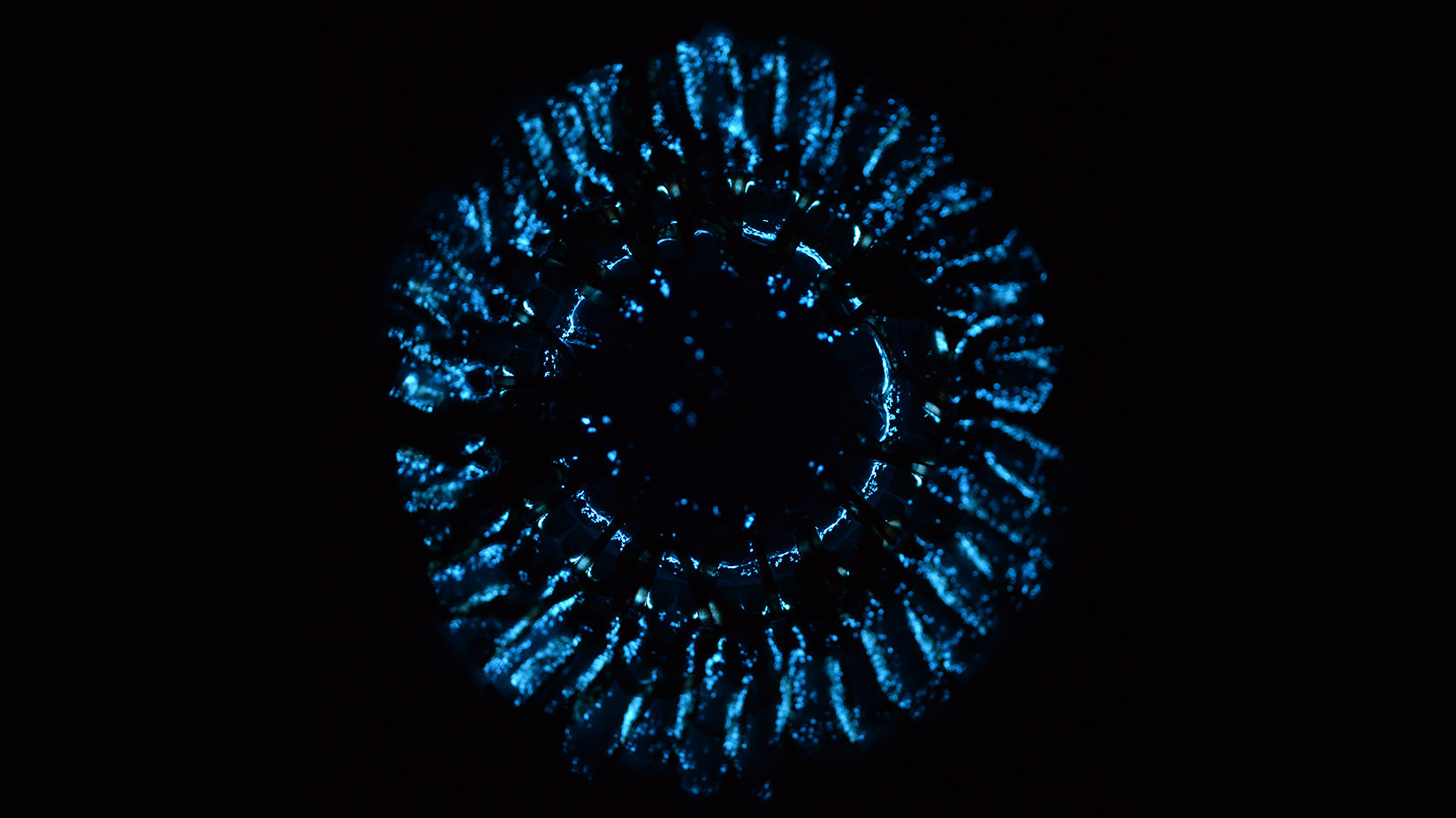
Featured image: Atolla jelly lighting up the pitch-black ocean (Image credit: Steve Haddock/Monterey Bay Aquarium Research Institute)
Sparkling blue waves in the night are often seen near beaches. For centuries, Greek sailors believed the glowing waves to be the work of Poseidon (God of the sea) or his nymphs. Others considered them omens — a sign of sea monsters or spirits. Today, this mesmerizing phenomenon is known as a natural wonder called bioluminescence. And the stunning light show is a present to us from tiny dinoflagellates that emit vibrant blue-green light.
Just beyond the twilight, the ocean looks like a dark, endless void. Characterized by increasing pressure, cold temperatures, and little food, the bottom of the ocean is deeper than one can imagine. The deepest point of the ocean, the Challenger Deep in the Mariana Trench, at an approximate depth of 11,000 meters. It is deeper than the height of Mount Everest (8,849 m) – the highest mountain on Earth . Sunlight, the primary source of energy and light on Earth, can only penetrate up to about 1000 meters in the water column. The vast abyssal zone below remains devoid of sunlight. Yet, the lack of sunlight does not prevent life from flourishing in the deeper oceans.
The only sources of light are the life residing in the dark aphotic zone. These creatures have evolved to create light of their own, just like the fireflies on land.
This phenomenon, when living beings can naturally produce and emit light, is widely known as bioluminescence.
Light is produced as a result of a chemical reaction when luciferin (a light-emitting compound) oxidizes in the presence of the enzyme luciferase. The names luciferin and luciferase originate from Lucifer, which is a Latin word that means ‘light bearer’. The molecular structures of these two compounds differ from species to species.
Although bioluminescence is a rare occurrence among terrestrial animals, it is a familiar trait in the ocean. A study conducted by Martini and Haddock showed that about 76% of marine organisms are bioluminescent. From single-celled phytoplankton on the surface to deep-sea fish, this phenomenon is observed in a diverse range of species. When deep-water trawling became possible below 1200 feet in the 19th century, it was discovered that nearly all specimens exhibited a bioluminescent nature.
Marine organisms like jellyfish, squids, fish, and crustaceans, as well as some bacteria exhibit bioluminescence.
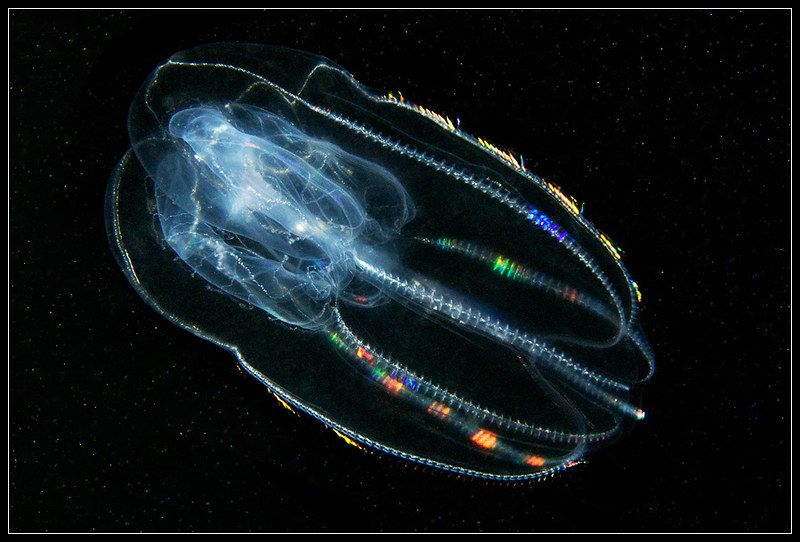
In the deep sea, animals flaunt a variety of colors. Deep-sea shrimp, comb jelly (ctenophores), hatchetfish, and many other oceanic creatures emit blue light. The Atolla jellyfish produces intense blue light with occasional red flashes. The angler fish uses a blue-green lure to attract prey.
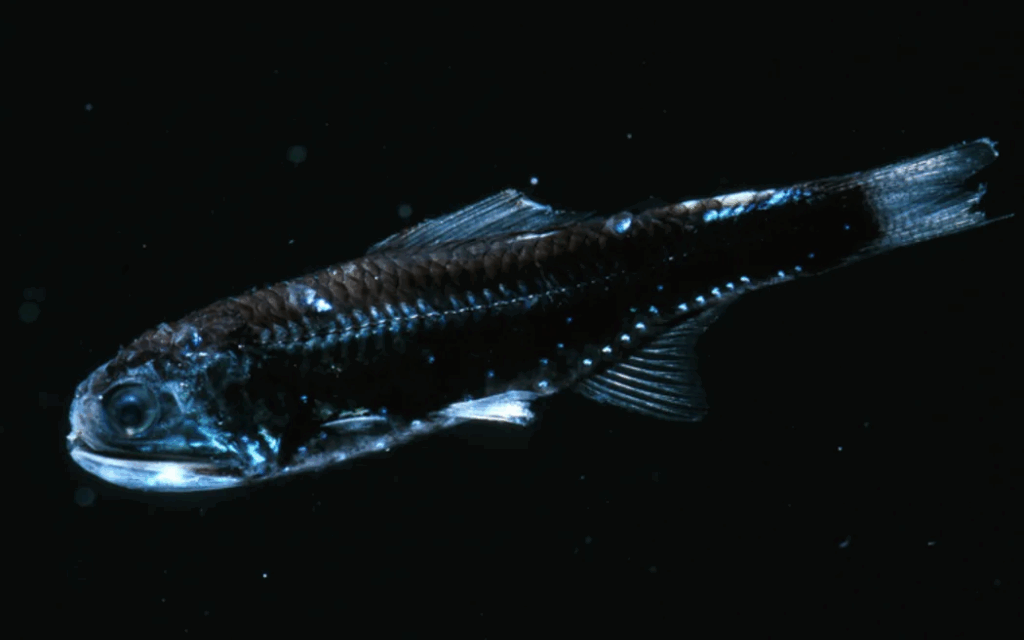
Another abundant fish in the abyssal zone, known as the lantern fish, also emits blue light from photophores, or light-producing organs, located throughout its body.
Interestingly, the deep ocean dragonfish glows red. It is an unusual attribute that aids in camouflage and predation. Most lights produced by deep ocean organisms are blue and green since these wavelengths are less likely to be absorbed and can travel longer distances than red lights.
In the abyss, food shortage is a major problem with no photosynthesis. For the majority of animals, the primary food source is organic materials such as fecal matter and decaying body parts of other organisms falling from the surface waters. These are known as ‘Marine Snow’. Some species rely on predatory methods to obtain food. Bioluminescence is an effective tool in searching for food in remote habitats. In dark abyssal waters, some animals use light to briefly illuminate the surroundings and reveal the position of prey. Lights are also used as lures to attract prey.
At the same time, it is also useful in order to escape predators. It enables organisms to detect potential dangers. A remarkable example can be seen in the case of certain brittle stars that can detach glowing body parts and escape by misleading their attackers. Therefore, bioluminescence provides better protection and can help organisms to hide in the dark ocean. Additionally, some bioluminescent species use their attractive lights to find mates. Some other marine animals use light signals to communicate with each other through warning flashes and group coordination. This ability of organisms to create light stands as a vital adaptation strategy in the deep ocean.
In addition to its many advantages, bioluminescence is a highly efficient reaction that produces very little heat. Hence, it is referred to as cold light. This makes it well-suited for deep-sea organisms where conservation of energy is very important.
Bioluminescence is a unique trait of nature, particularly essential in the case of abyssal animals. Despite being inhabitants of the deeper ocean, these are not immune to the impact of human activities. Deep-sea mining, extractive activities, pollution, and climate change have emerged as significant threats to the fragile ecosystems these bioluminescent species call home. As deep-sea explorations have increased over time, protecting these fragile ecosystems has also become crucial.
Marine life forms illuminate the dark realm, much like the stars in the night sky. In the dark abyss, where survival is an intense fight, bioluminescence is one of nature’s greatest blessings.
Leave a Reply